 ⭐️
⭐️
Over the past decade, the Modern Data Stack has changed how teams build data platforms. Data ingestion, lakehouses or cloud warehouses, dbt, orchestration, metrics layers, BI, and governance were split into modular building blocks that can be assembled more flexibly. That shift moved data platforms away from heavy, closed, tightly coupled systems and toward a more open and cloud-native engineering model.
But once teams run that model in production, another truth becomes clear: the quality, speed, and recoverability of the whole platform still depend heavily on the first step, data integration.
Because of that, the next key question in data engineering is no longer only "where data should live." It is also "how data enters the platform continuously, reliably, and in a governed way." From that perspective, Apache SeaTunnel is more than a connector catalog. It is better understood as a data integration runtime for modern platforms and future agent-driven systems.
1. Modern Data Stack made platforms more modular, but it still underestimates data ingress
The Modern Data Stack deserves real credit. It separates responsibilities more clearly: ingestion handles extraction, a lakehouse or warehouse provides unified storage and compute, dbt handles much of the transformation layer, orchestration manages lifecycle, and governance, quality, metrics, and BI deliver value to the business.
That separation makes technology choices easier. But in real production systems, the ingestion layer is often the most underestimated part. "Just sync the data in" is rarely a connector-only problem. It quickly becomes an operational problem: CDC, incremental capture, schema drift, source pressure, recovery after failure, duplicate prevention, and downstream data quality.
In other words, Modern Data Stack helped teams appreciate lakehouses and modeling more deeply, but the next step is to recognize the engineering value of the integration layer itself. It decides whether every downstream layer sees complete, timely, consistent, and recoverable data.
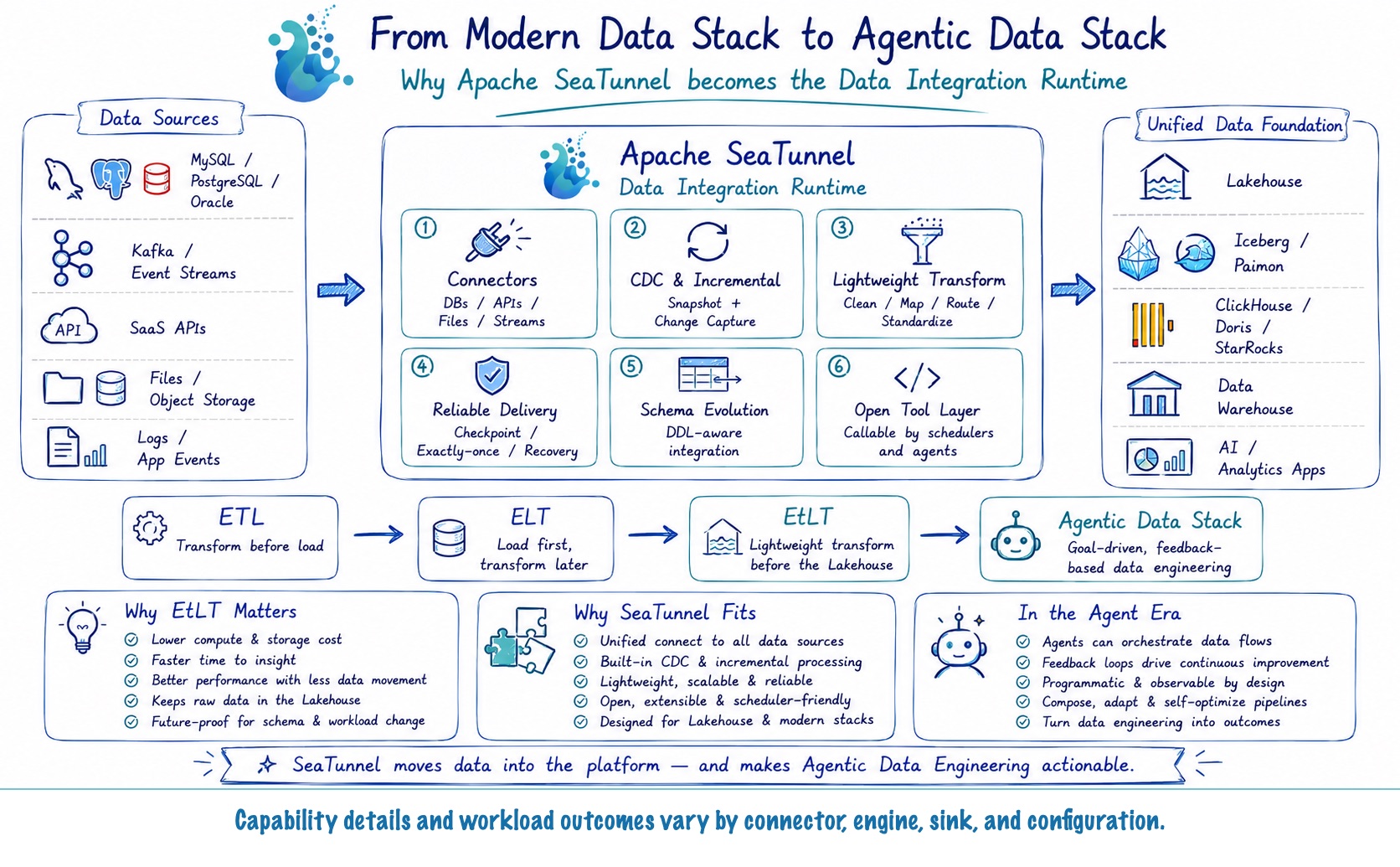
2. From ETL to ELT to EtLT: the real shift is responsibility, not terminology
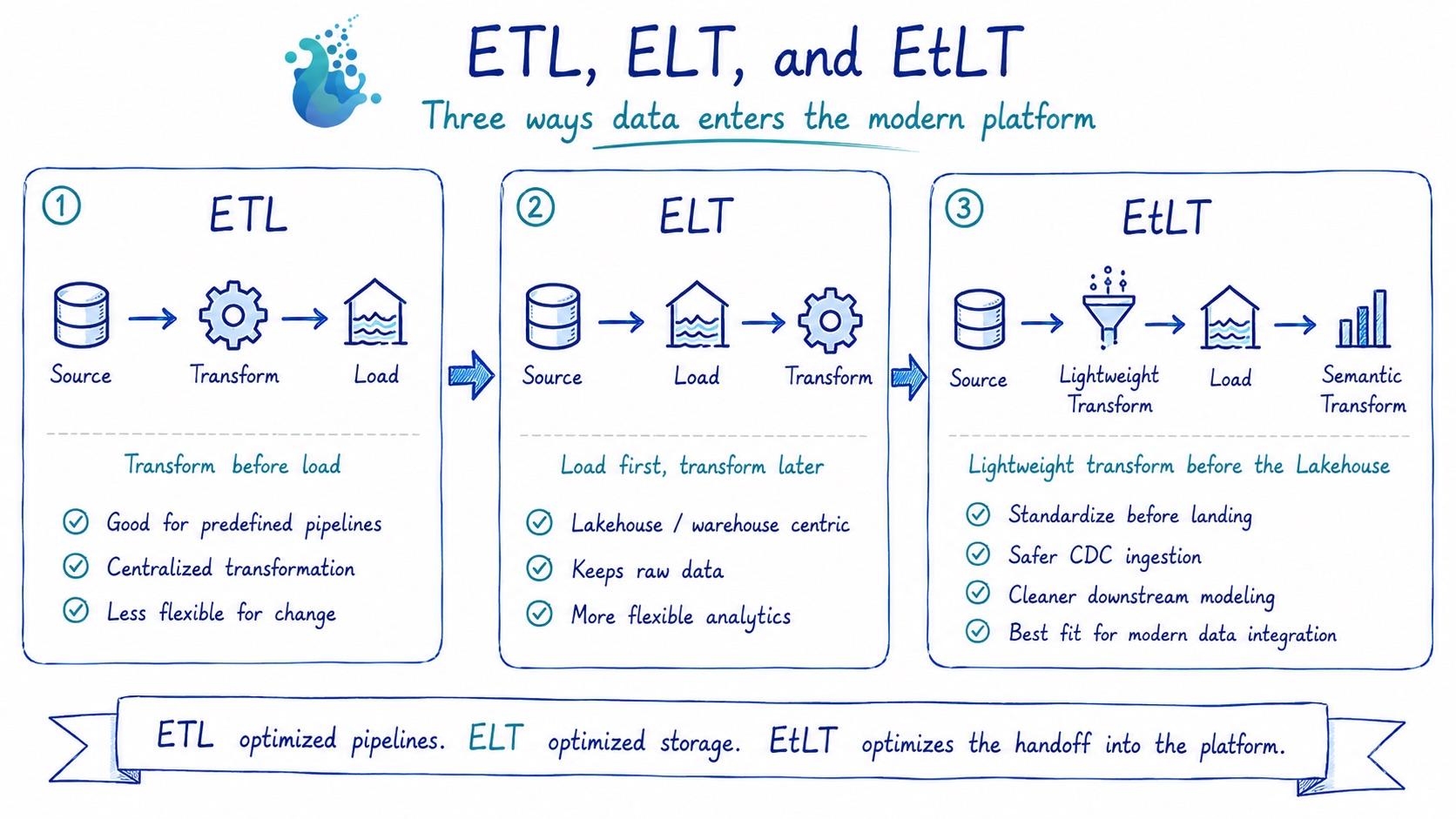
Traditional ETL transforms data before loading it. That works well when rules are stable and business change is limited. The downside is a heavy front-loaded pipeline that becomes harder to maintain as change accelerates.
ELT moved more responsibility to the destination. Teams extract first, load into the lakehouse or warehouse, and transform later. That takes advantage of stronger storage and compute at the platform layer, preserves more raw data, and gives analytics teams more flexibility.
But pure ELT is not always the best answer. If everything is loaded first and cleaned up later, schema drift, dirty fields, CDC inconsistencies, sensitive columns, duplicate rows, and format differences all move into the platform unchanged. Lakehouses, dbt models, semantic layers, and analytics teams then pay the price for problems that should have been handled earlier.
That is why EtLT matters. EtLT does not mean going back to heavyweight ETL. It means adding a necessary lightweight transformation stage before loading: standardization, filtering, mapping, routing, CDC event normalization, and structure adaptation before data lands in the unified foundation. The big semantic transformation still belongs to dbt, SQL models, and semantic layers later.
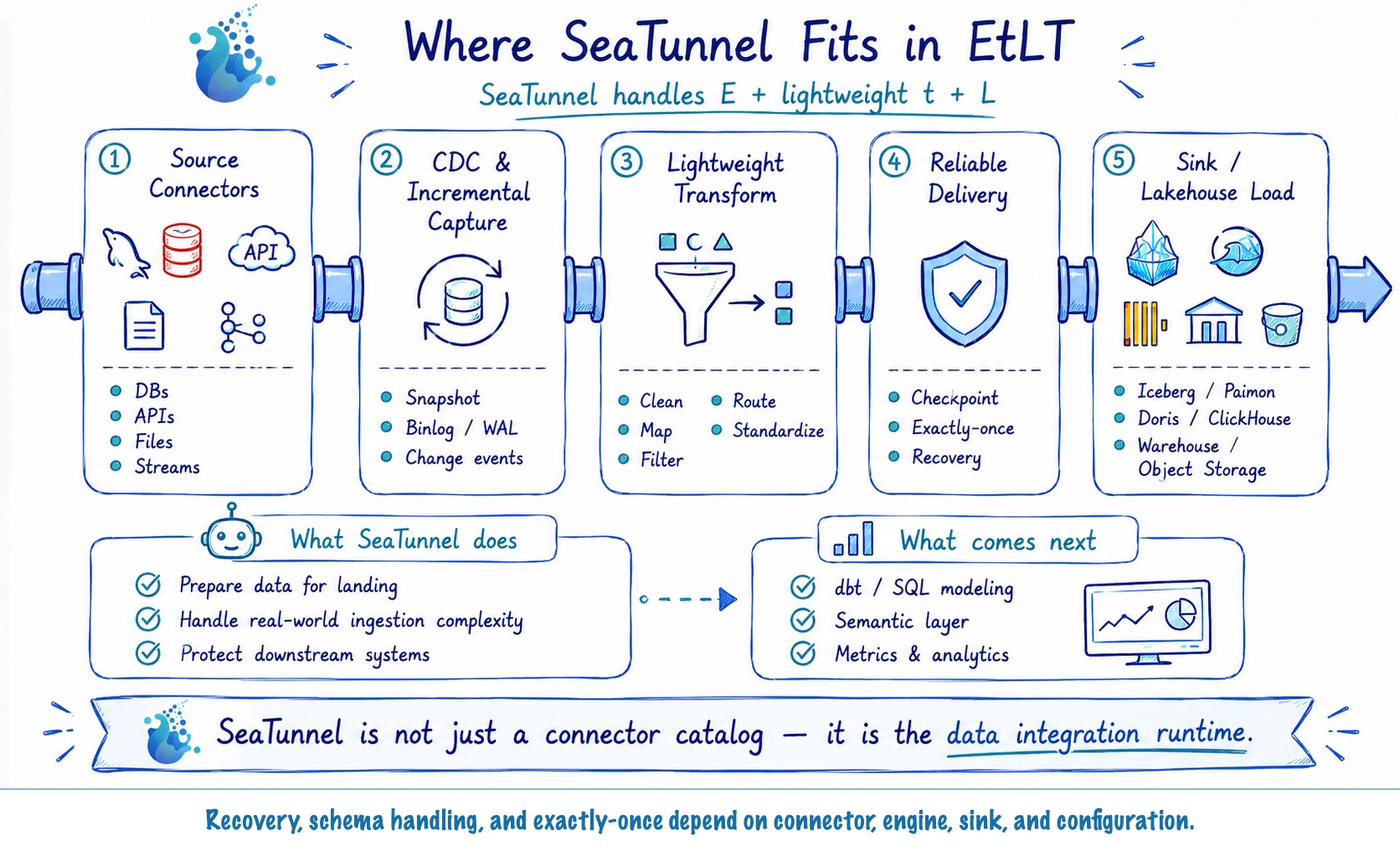
3. SeaTunnel fits naturally in EtLT as a runtime, not just a list of connectors
Once we look at EtLT, SeaTunnel's role becomes straightforward. It fits the E + lightweight t + L part of the stack: connecting heterogeneous sources, running CDC or incremental ingestion, applying lightweight transformation, and delivering data into lakehouses, engines, or downstream storage.
That is the difference between SeaTunnel and a simple connector catalog. The real question is not just whether a system can connect. It is whether it can keep running, recover from failure, handle state, and prepare data so downstream systems can consume it safely.
Seen that way, SeaTunnel is more accurately described as a data integration runtime for modern data platforms. Depending on the connector, engine, and configuration, it can support patterns such as checkpoint-based recovery, schema-aware handling, and reliable delivery. That is exactly the layer EtLT needs.
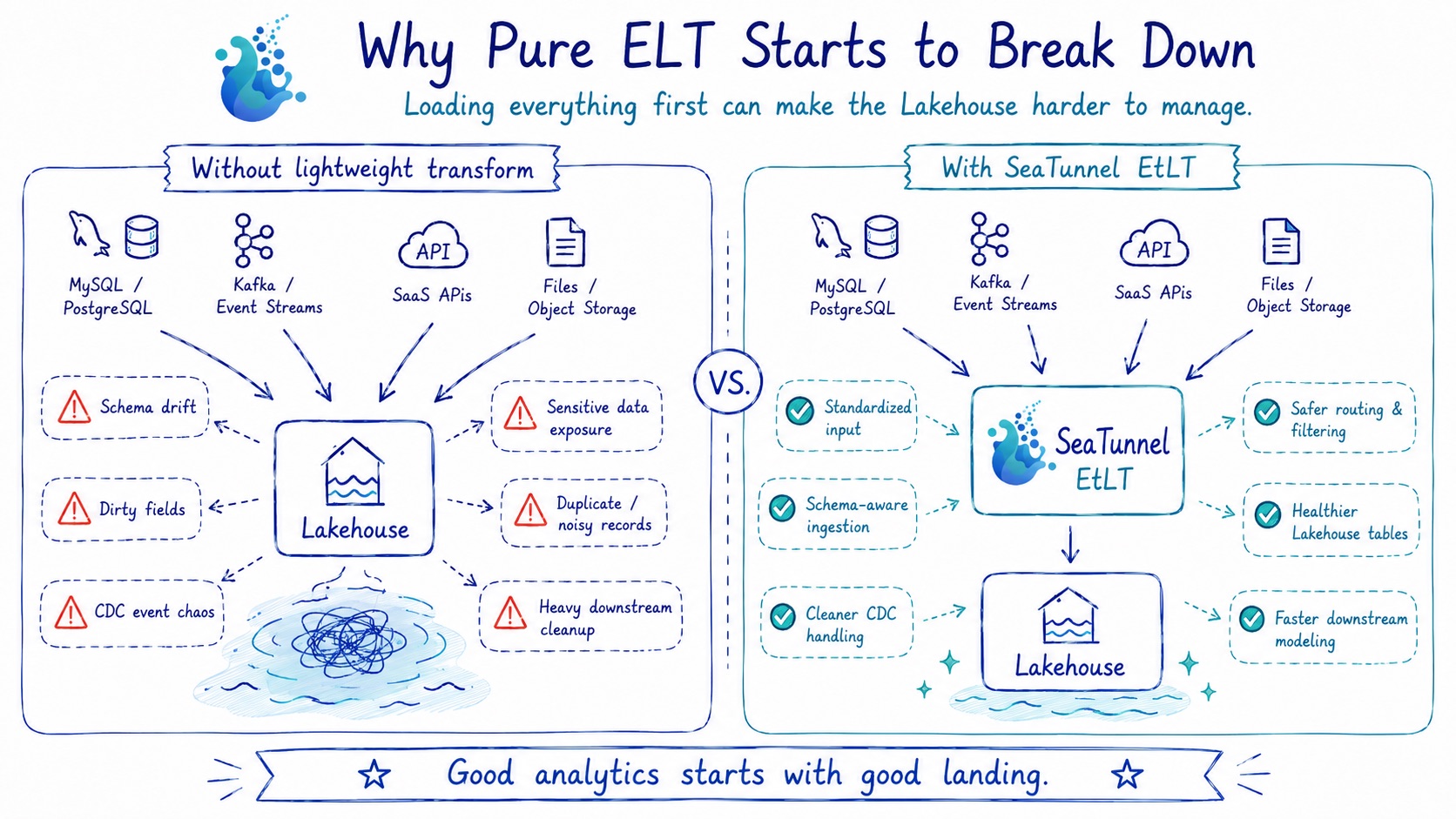
4. Why pure ELT starts to break down
Many teams naturally start with pure ELT: if the lakehouse is powerful enough, load everything first and clean it up later. That works in early or exploratory stages. But once the environment includes frequent change, CDC, heterogeneous sources, and always-on production pipelines, the cracks show quickly.
Schema drift can land directly in the platform and make tables harder to manage. Dirty or sensitive columns can increase governance and compliance cost. CDC events from different systems can force downstream models to absorb unnecessary complexity. Duplicate or noisy records can make analytics depend on more and more compensating cleanup.
EtLT addresses this by improving the landing step. It is not about moving all business logic back upstream. It is about making sure the platform receives healthier input: standardized data, schema-aware handling, normalized CDC events, and the filtering or routing that should happen before storage.
5. In the agent era, SeaTunnel becomes more important as an execution layer
If Modern Data Stack made tools modular, Agentic Data Stack makes tools callable. Future platforms will not only rely on people clicking through UIs, configuring jobs manually, and reading logs after the fact. They will increasingly include agents that interpret goals, reason over lineage and impact, choose actions, validate outcomes, and improve over time.
In that loop, agents handle understanding and decision-making. They identify intent, analyze dependencies and blast radius, decide whether a problem needs ETL, ELT, or EtLT, and choose the right tools and risk boundaries.
SeaTunnel's role is different. Through execution APIs, orchestration integrations, or higher-level control layers, it can serve as the data execution layer that turns plans into actual movement: synchronization, CDC ingestion, controlled reruns, selective reload workflows, and recoverable delivery. Agents are useful only when they can act through reliable systems, and that is where a runtime like SeaTunnel matters.
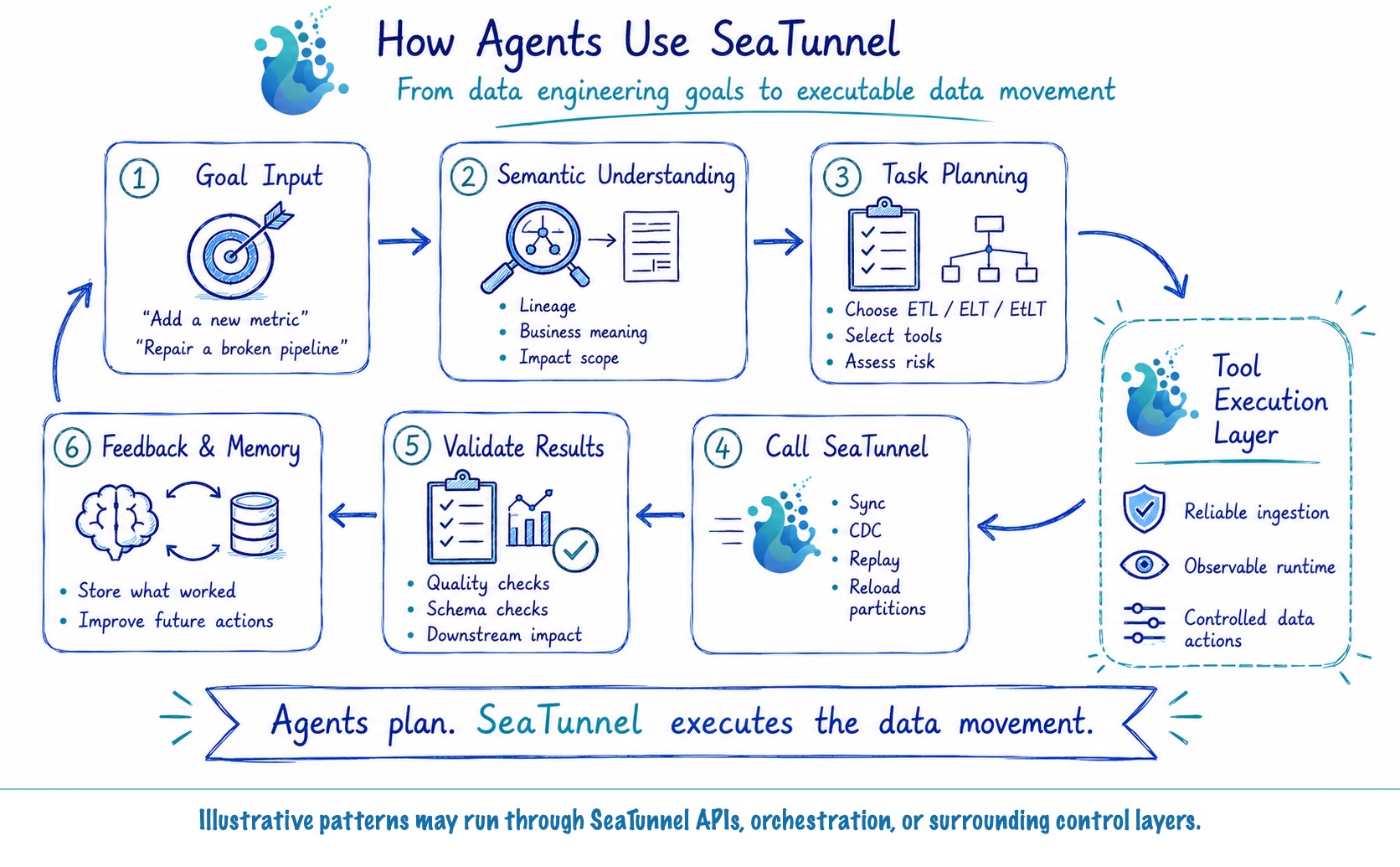
6. SeaTunnel is not just a component of Modern Data Stack, but part of the runtime foundation of Agentic Data Stack
Viewed as a layered system, the next generation of data engineering platforms may look something like this: data sources at the bottom, then a data integration runtime, then a unified data foundation, then transformation and semantics, then orchestration and governance, and finally an agent layer on top.
In that structure, SeaTunnel sits in a critical position. It turns heterogeneous change from the real world into standardized, continuously ingestible input for the platform. Without that layer, the lakehouse is mostly a passive container. With it, the lakehouse has a better chance to become a reliable foundation of truth.
That is why SeaTunnel should not be treated as only a "sync tool." In the Modern Data Stack, it carries real production-grade integration responsibilities. In the Agentic Data Stack, it becomes part of the runtime infrastructure that allows data engineering systems to move from analysis to action.
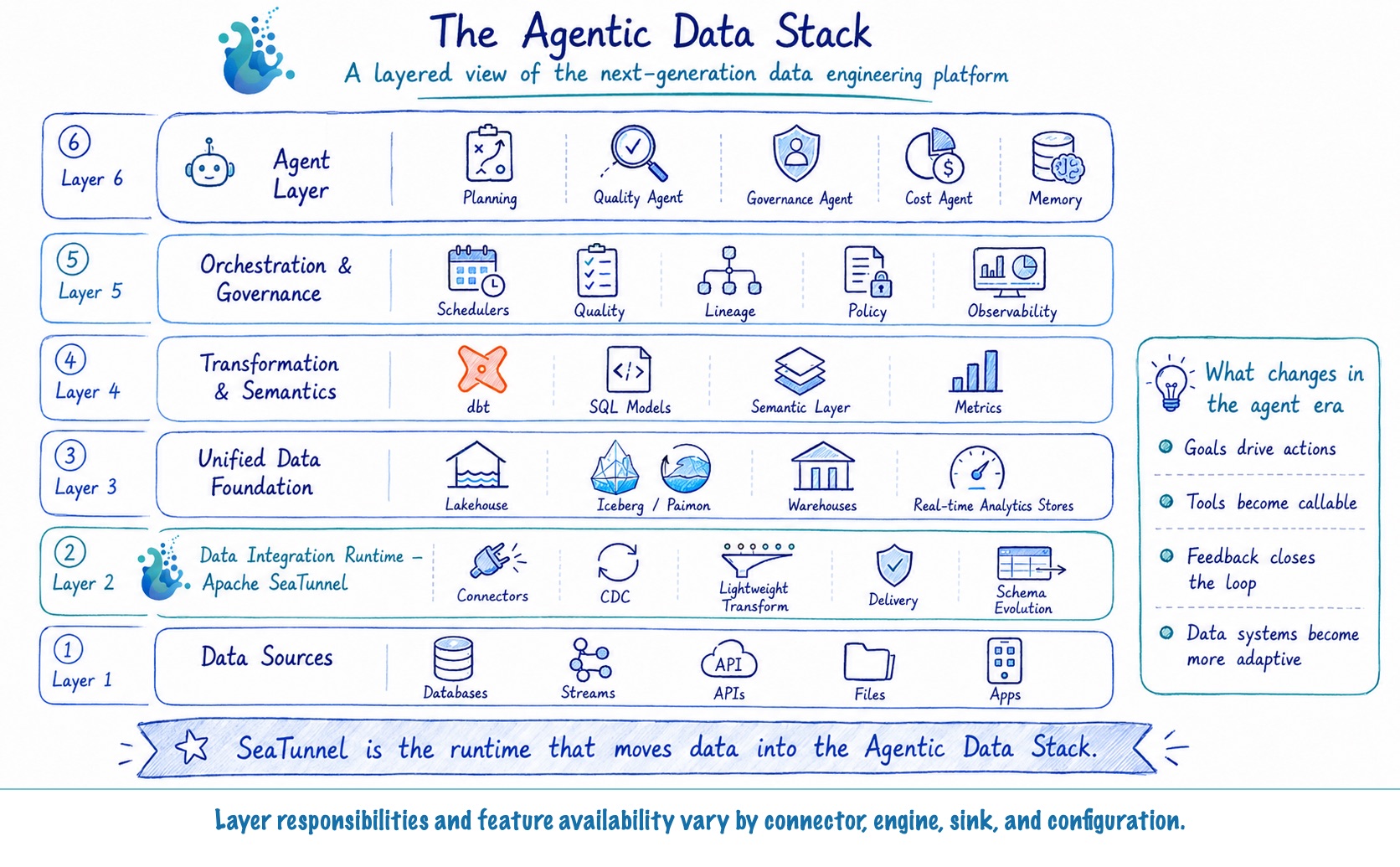
Conclusion
The shift from Modern Data Stack to Agentic Data Stack is not just about adding an LLM interface. It is about changing the operating model of data engineering: people define goals, systems generate actions, tools execute those actions, and feedback improves the next round.
In that world, lakehouses matter, dbt matters, orchestration matters, and governance matters. But the question of who brings real-world data into the platform in a reliable and recoverable way still points to the data integration runtime.
That is where Apache SeaTunnel stands out. It is not merely a catalog of connectors. It is one of the layers that makes the rest of the platform operational.